What the Ace of Cups means in Tarot
The Ace of Cups opens the emotional suit and represents a cup filling with new feeling. It is associated with openness, compassion, creative flow, and the willingness to receive an experience before protecting yourself from it.
The Ace of Cups does not guarantee that an emotion will become a relationship or a success. It shows potential that needs attention, honesty, and room to develop over time.
- New Love
- Emotional Opening
- Compassion
- Creativity
The card’s main theme
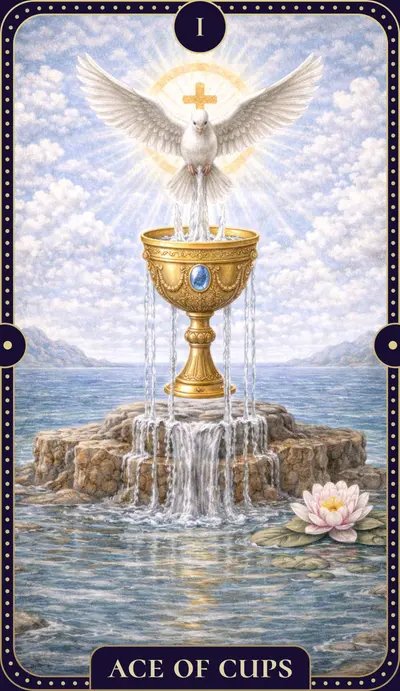
The Ace of Cups is the first overflow of the water suit: feeling that arrives before you’ve decided what to do with it. A hand reaches out of a cloud holding a golden chalice marked with an inverted M; five streams spill over its rim into a pond covered with water lilies, and a white dove descends toward the cup carrying a small round wafer stamped with a cross. The overflowing water shows emotion too large to contain, the lilies show feeling rooted in something deeper than mood, and the dove shows grace that you can receive but not manufacture. The card doesn’t ask you to earn the cup, only to hold it out.
How this card can appear in life
The Ace of Cups appears when a friend’s baby is placed in your arms for the first time, when a stranger’s kindness reduces you to tears on a hard day, when you adopt a dog from a shelter, when a song you write finally sounds right, or when someone says “I love you” and means it. It favors counseling, music, nursing and volunteer work. Sometimes it describes a first meditation retreat or a return to prayer. Its shadow is emotional flooding, or refusing love because it feels unsafe.
The person’s inner state
Softness is the first thing you notice: a chest that feels warm, eyes that sting, defenses that drop without asking permission. You may feel grateful for no clear reason. The pond beneath the cup suggests that none of this water is wasted; it gathers and feeds what grows next.
The card’s question
- What have you been offered recently that you were too guarded to receive?
- Where does your cup overflow, and where is it quietly running dry?
- Who could you hand the chalice to without expecting anything back?
Interpretation examples
What does the Ace of Cups say about adopting a rescue dog?
Upright, it signals a bond that will bring real comfort into your home. Reversed, it suggests checking whether you have the time and emotional room right now, or whether you’re trying to fill a gap too quickly.
How does the Ace of Cups show up for a songwriter?
It describes a surge of feeling that finally finds words and melody. Reversed, the emotion is there but stuck, and it may help to write badly on purpose to get it moving.
What does the Ace of Cups say about volunteering?
Upright, it favors work that lets you give care directly and receive meaning in return. Reversed, it warns of compassion fatigue if you give without refilling.
Upright meaning
The Ace of Cups upright points to a new feeling, reconciliation, inspiration, or a moment of inner fullness. Let emotion move, while staying connected to practical boundaries and real needs.
Reversed meaning
The Ace of Cups reversed can indicate emotional exhaustion, guardedness, fear of vulnerability, or feelings that lack mutual space. Begin by restoring your connection with yourself.
Advice from the Ace of Cups
Name the feeling that wants to be heard and create a safe place for it. Accept support or inspiration, but do not demand a finished result from the first spark.
Explore a related Tarot spread Get a reading in the appAce of Cups Tarot meaning in love and relationships
In love, the Ace of Cups means an opening of the heart: budding love, deep emotional closeness, sometimes a pregnancy or new tenderness in a couple. For singles, it is a sign that readiness for love is already there. In reverse, the Ace points to suppressed feelings, emotional fatigue, or a guardedness that makes it hard to accept attention.
Ace of Cups Tarot meaning in career and finances
Professionally, the Ace of Cups means work you care about: a creative offer, a new role involving people, a job with tangible meaning. It supports projects in care, the arts, and education. When reversed, it shows burnout, lack of inspiration, or an offer that does not resonate inside.
Notable card combinations
- The Empress
Fertility, pregnancy or a deeply creative season.
- Ten of Cups
Romance that eventually fills a house with children.
- Page of Wands
A flirtation with real emotional potential.
- The Moon
Strong feelings clouded by uncertainty or idealization.
- Five of Swords
An emotional opening meets a hurtful remark; tread carefully.
- King of Pentacles
Feelings find stable ground and practical support.
Ace of Cups Tarot card FAQ
What does the Ace of Cups mean in Tarot?
The Ace of Cups represents new feelings, emotional openness, inspiration, and potential for inner renewal. Reversed, it can point to emotional exhaustion, guardedness, fear of vulnerability, or feelings that lack mutual space.
What does the Ace of Cups mean in love?
In love, it can point to a new connection, sincerity, reconciliation, or deeper emotional contact. It shows potential, not a guarantee of mutuality or lasting commitment.
Is the Ace of Cups a yes or no card?
Yes: five streams pour from the chalice, which is about as generous as a card gets, above all for matters of affection or making up. Turned over, it gives “likely no,” as the water runs out onto the ground and whatever you feel is not being returned just yet.
Can the Ace of Cups indicate pregnancy?
Traditionally, yes. The overflowing chalice is one of the classic images of new life, especially alongside the Empress or the Page of Cups. On its own, it may just as well describe a new relationship or a creative birth.
What does the Ace of Cups mean for someone’s feelings toward you?
It shows open, sincere affection, often stronger than the person has admitted. They feel moved by you and may be ready to say so.
What does the reversed Ace of Cups mean?
Upside down, the chalice empties: love goes unanswered, feelings are bottled up, or you feel hollow and can’t say why. It can also point to someone who gives affection freely to everyone except themselves.