What Death means in Tarot
Death is the thirteenth card of the Major Arcana and represents deep change, the end of a cycle, and a transition into a new state. Its imagery suggests that an old format no longer supports growth and needs an honest conclusion.
Death usually does not mean physical death. It can describe the end of a job, habit, relationship stage, or self-image, gradually making room for a different way of living.
- Endings
- Transformation
- Release
- Renewal
The card’s main theme
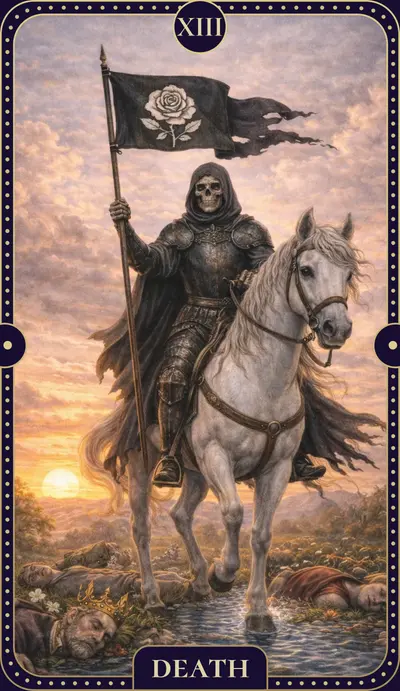
Death is the card of endings that make room: something has run its course, and holding on costs more than letting go. Death arrives as an armored skeleton on a pale horse, gripping a dark flag emblazoned with a white rose. A crowned king has already fallen under the hooves; a bishop in gold vestments pleads, a maiden turns aside, and a small child gazes up unafraid. Far off, a boat drifts downriver and the sun comes up between two towers. The fallen king shows that endings spare no rank, the white rose shows purity and renewal, and the rising sun shows that the story continues past this point. The card rarely speaks of physical death.
How this card can appear in life
Death appears when you close a business, finalize a divorce, move out of your childhood home, quit a career you trained years for, leave a religion, or finally throw out the letters you kept from an ex. It favors decisive endings, clearing out and starting fresh. In health it usually signals a major lifestyle change rather than danger. Its shadow is clinging, keeping something on life support long after it has died.
The person’s inner state
Grief and relief share the same breath. Something is ending, and even if you chose it, it still hurts. There may be fear of the empty space that follows. The child looking up at the rider shows that fresh eyes can face change without dread.
The card’s question
- Which chapter is already over, whatever you keep telling people?
- Which of the figures in front of the horse are you right now: the king, the bishop, the woman or the child?
- What would you have room for if you let this chapter close?
Interpretation examples
What does Death say to a shop owner selling off the last of the stock?
Upright, the shop has done its job, and shutting the doors with dignity leaves room for a next chapter. Reversed, savings keep going into a store that stopped paying for itself long ago.
How does Death show up after a long relationship ends?
It describes a real ending that needs to be grieved rather than reversed. Reversed, it shows going back and forth, unable to let the relationship go.
What does Death say about leaving a career you trained for?
Upright, it supports a clean break and a real change of identity. Reversed, it warns that fear of starting over keeps you in a role that no longer fits.
Upright meaning
Death upright points to an unavoidable transition, clearing away, and readiness to release what has run its course. The change may be emotionally difficult, but an honest ending returns energy to you.
Reversed meaning
Death reversed can indicate resistance to an ending, fear of the unknown, or an attempt to preserve a pattern that is no longer viable. Name what you are holding onto and make the transition manageable.
Advice from Death
Acknowledge what has ended and remove one concrete remnant of the old pattern. Do not demand an instant new beginning; make room for the transition first.
Explore a related Tarot spread Get a reading in the appDeath Tarot meaning in love and relationships
Death in relationships is the end of one stage and the start of another, not a prediction of separation. A couple can reach a new level if both are ready to release old roles; for someone single, the card helps close an old attachment. In reverse, it shows clinging to what has already ended, fear of change, and a drawn-out goodbye.
Death Tarot meaning in career and finances
In career matters, Death means closing a cycle: a layoff, a reorganization, a career change, the end of a project. It is time to clear space for the new rather than mourn the old. When reversed, it points to resisting the inevitable, trying to revive what is outdated, and wasting time on old schemes.
Notable card combinations
- The Tower
A sudden ending that clears the ground completely.
- Six of Swords
Leaving the past behind for calmer waters.
- Ace of Wands
A new beginning rises from what ended.
- Four of Pentacles
Clinging to the old shape of things wears you out.
- Ten of Cups
A family transition, such as a move or a new phase of life.
- Knight of Cups
A new romantic chapter after a painful ending.
Death Tarot card FAQ
What does the Death card mean in Tarot?
Death represents the end of a cycle, transformation, and release from what no longer works. Its meaning is usually symbolic change, not a prediction of physical death.
Is Death a bad Tarot card?
Not necessarily. It can describe a difficult but necessary transition and the chance to renew your direction.
Is Death a yes or no card?
Likely no: the rider has closed this chapter, so what you’re hoping for won’t return in its old form. Reversed, the answer is “unclear for now,” since you’re resisting the change and everything is on hold.
Does the Death card mean someone will die?
Almost never. In tarot, Death stands for transformation and the end of a phase rather than a literal death. It is far more likely to describe a breakup, a move or a career change.
What does Death mean in love?
For couples, Death marks the close of one version of the relationship, sometimes the whole thing, sometimes just the old rules. A relationship may end, or it may shed an old pattern and become something completely different.
What does Death reversed mean?
Upside down, Death is the ending you keep postponing: the room stays frozen, and nothing new can start. It can describe a long, stalled ending in which both people know it’s over but neither says so.